Reaching for the Skies - Season 1
Season 1

Episodes

The Pioneers
This programme tells the story of aviation pioneers, both men and machines, with specially shot sequences, interviews with people involved and archive film not seen before on television.
The Aeroplane Goes to War
Shortly after man first achieved powered flight, his new invention was harnessed for battle. The First World War was to be a catalyst for the development of the aeroplane. It added a whole new dimension to warfare - air power.
Trailblazers
Flying between countries and continents is an accepted way of life to millions of people. But as their airliners cruise along at hundreds of miles an hour, tens of thousands of feet above the earth, how many spare a thought for those early pioneers?
Lighter Than Air
Paris, November 1783: an awe-struck crowd in the Bois de Boulogne watched as a balloon built by Joseph and Etienne Montgolfier rose into the sky.
Later, magnificent airships, became luxurious liners of the skies. But the disasters of the R101 and the Hindenburg brought this chapter to a fiery end.
Bombers
On 6 August 1945, a B29 bomber, called Enola Gay after the captain's mother, dropped an atomic bomb on the Japanese city of Hiroshima. Seventy-eight thousand people died immediately. It was the ultimate in terror bombing. An aeroplane first dropped a bomb just eight years after the Wright brothers first flew. A new and horrific dimension to warfare had arrived. Conventional bombing reached its climax in the Vietnam War, when the United States, in a ten-year-long campaign dropped six-and-a-half million tons of bombs. More than was used in the whole of the Second World War.
Quest for Speed
In 1909 Glenn Curtiss took his wood and fabric Pusher bi-plane to Rheims for the world's first air races.
Louis Bleriot started as favourite, but Curtiss took the trophy at a record 461 miles an hour. Soon fans on both sides of the Atlantic were flocking to race meets. Fierce international rivalry built up to produce the fastest flying machines in the world. The RAF Spitfire was a direct descendant of racing planes. In Hitler's Germany, scientists produced revolutionary rocket and jet-powered fighters - the fastest of the war. Less than 40 years after Curtiss set his record, man broke through the sound barrier.
Giants of the Air
From the moment man first took to the skies, the dream has been to build bigger and bigger aircraft. The early designers saw the advantages that large aeroplanes would bring as passenger and cargo carriers. The military also needed them to carry troops and drop bombs. The problem in the early days was the lack of engine power. It was the invention of the jet engine that finally provided the answer to the designers' dreams. A new generation of huge aircraft were born - planes like the C5 Galaxy which is capable of carrying more than a 100 cars.
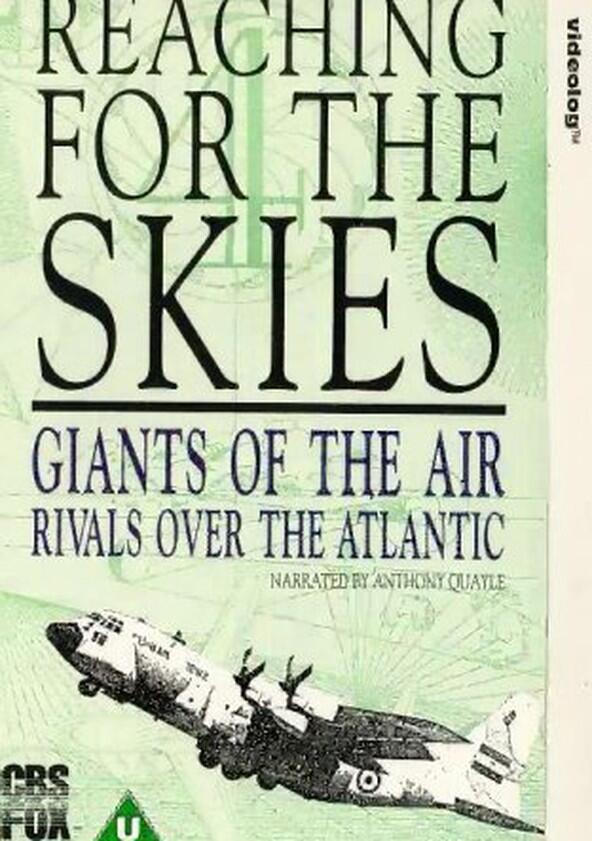
Rivals Over the Atlantic
Of all the air routes in the world, none have been more fiercely contested than those between Europe and the United States. The invention of the jet engine was to signal the start of the second battle of the Atlantic - the combatants were the giant aircraft manufacturers and airline operators - De
Havilland and Boeing, BOAC and Pan Am. As the airline passenger market grew in the 60s and 70s, Boeing emerged the clear leader. Europe's gamble on speed with Concorde had failed - size and economy had won. The 747 Jumbo jet was the king of the airliners.
Fighters
One aircraft above all others demonstrates man's mastery of the skies - the fighter. The men who fly them, an elite among pilots. From the Second World War to Korea, the Middle East and Vietnam, the fighter's role has remained the same. A unique partnership between man and machine, designed to seek out and destroy the enemy.
Vertical Flight
The problem of designing a machine capable of taking off and landing vertically was perhaps the greatest challenge faced by the early aviation pioneers. When the Germans and then the Russian emigre,
Igor Sikorsky finally solved the complicated physics involved, the world quickly benefited from an ultimately flexible aircraft - the helicopter. The military were quick to realise its potential, indeed the Americans fought a war with it - Vietnam. With the advent of the jet engine though, came a new breed of vertical take-off aircraft. One was to outlast, outperform and outmanoeuvre all its rivals - the Harrier jump jet. As airport congestion grows, vertical-flight aircraft will be a vital part of the future of aviation.
Victory Over the Sea
Early in the Second World War, aircraft began to wrest the traditional control of the sea from the battleship.
Flimsy Swordfish biplanes, launched from Royal Navy aircraft carriers, flew daring torpedo raids which crippled the Italian fleet at Taranto and the giant German battleship, Bismarck. In the Pacific, American and Japanese carrier-borne aircraft attacked each other's fleets. A new warfare had developed. British innovations like the angle-deck allowed faster, heavier jet aircraft to land at sea, leading to the giant American super-carriers of today.
The Adventure of Flight
Why do people fly? What is it about flight that has fascinated man for centuries? Pilots speak of it as a privilege. There's a common bond among them all. A dedication to excellence.
Some have called it the 'right stuff, others 'the touch', all talk of 'the freedom'. Richard Bach , former test pilot and author of Jonathan Livingstone Seagull captures the essence of this adventure of flight.
Recently Updated Shows

NCIS
NCIS (Naval Criminal Investigative Service) is more than just an action drama. With liberal doses of humor, it's a show that focuses on the sometimes complex and always amusing dynamics of a team forced to work together in high-stress situations. Leroy Jethro Gibbs, a former Marine gunnery sergeant, whose skills as an investigator are unmatched, leads this troupe of colorful personalities. Rounding out the team are Anthony DiNozzo, an ex-homicide detective whose instincts in the field are unparalleled and whose quick wit and humorous take on life make him a team favorite; the youthful and energetic forensic specialist Abby Sciuto, a talented scientist whose sharp mind matches her Goth style and eclectic tastes; Caitlin Todd, an ex-Secret Service Agent; and Timothy McGee, an MIT graduate whose brilliance with computers far overshadows his insecurities in the field; Assisting the team is medical examiner Dr. Donald "Ducky" Mallard, who knows it all because he's seen it all, and he's not afraid to let you know. From murder and espionage to terrorism and stolen submarines, these special agents travel the globe to investigate all crimes with Navy or Marine Corps ties.

Landman
Set in the proverbial boomtowns of West Texas, Landman is a modern day tale of fortune seeking in the world of oil rigs. The series is an upstairs/downstairs story of roughnecks and wildcat billionaires fueling a boom so big, it's reshaping our climate, our economy and our geopolitics.

The Creep Tapes
Based on a collection of videotapes in the secret vault of the world's deadliest and most socially uncomfortable serial killer, who hires his victims to film him for the day under false pretenses, each episode exposes a new victim from one of the fabled 'Creep Tapes'.

America's Funniest Home Videos
ABC's longest-running primetime entertainment show, America's Funniest Home Videos, returns for season 36 this fall with the same mission -- giving families something genuinely funny to enjoy together on Sunday nights.
"AFV," the longest-running primetime entertainment show in ABC history, returns for season 36 with the same mission - to provide viewers with hysterical moments that fly by at a dizzying pace.

The Real Housewives of Potomac
Just up the river from our nation's capital lies a hidden gem—Potomac, Maryland. Its rolling hills, gated mansions, sophisticated prep schools, and exclusive country clubs all serve to keep the area invitation-only. Sprinkled throughout this community are a handful of old-line, wealthy African-American families who have historically broken racial barriers to provide a life of privilege for their children. The Real Housewives of Potomac follows the upscale lives of six intriguing, well-to-do women: Gizelle Bryant, Katie Rost, Karen Huger, Charrisse Jackson-Jordan, Robyn Dixon, and Ashley Darby, all of whom have fought for their places in this society by way of legacy or marriage. In a town where entry is granted only through class, pedigree, and lineage, how far will these ladies go to secure their spot at the top of this prestigious circle?